Showing posts with label indicator. Show all posts
Showing posts with label indicator. Show all posts
Thursday, November 14, 2013
3 Level Audio Power Indicator

This circuit is designed to indicate the power level output of any audio amplifier. Its simple, portable, and displays three power levels can be adjusted to any desired value. For a standard power amplifier hi-fi stereo, the output values suggested are:
- D5 illuminates at 2W
- D4 illuminates at 12.5W
- D3 illuminates at 24.5W

Friday, November 8, 2013
Alarm Indicator for High Temperature Reading
The circuit has been designed to provide an alarm with the use of a buzzer when sensing high temperature by using a thermistor.
These bipolar transistors form a Darlington pair to produce a very high current gain that is much higher then each transistor taken separately. This is made possible when the current amplified by the first transistor is further amplified by the second transistor. The overall gain is equal to the two individual gains multiplied together.A Darlington pair is designed in such a way that the collectors of both transistors are attached together and the emitter of the first transistor is directly coupled to the base of the second or output transistor. The base current of the output transistor is equal to the emitter current of the input transistor. When several transistors are used, it can form a cascade connection and the total current amplification factor will be very high since it is a product of current amplification factor of respective transistors.
Alarm Indicator for High Temperature Reading Schematic

When the Darlington pair conducts in this circuit, it causes the relay K1 to close thereby triggering the buzzer to produce sound due to the increase in temperature that is more than the predetermined value. The location of the thermistor should be far enough from other components of the circuit to prevent inhibiting their temperature. The circuit is powered by a 9 V battery for ease of transportation but a dedicated power supply can be provided is the circuit would be in a permanent location. A load, like a lamp or a LED, can also be connected to the contacts of the relay to produce a light indication or notification of the occurrence of excess temperature. Since the circuit is well insulated, the thermistor, connected to the circuit with a plated cable, can be submerged to water to cool down or reset the sensitivity and will not cause any short circuit. Doing this will regulate the trimmer.
This circuit can be designed not only by setting a detection of high temperature but can also be modified to be set on detection of low temperature in some industries. It can be used for refrigeration, walk-in freezer, or walk-in cooler systems and other environments that are sensitive in temperature. Some circuits incorporating high temperature alarm modules are being used in motor vehicles to detect the occupancy wherein the temperature element senses a highly dangerous temperature in the passenger compartment of a motor vehicle and energizes the occupancy sensor to determine the presence or absence of an occupant. In the absence of the occupant, the sensor de-energizes after a period of time while an audible alarm is triggered to create attention to the motor vehicle in the presence of an occupant. This type of alarm can be reset with the use of a key.
Having a temperature alarm can provide benefits like protecting valuable equipment due to high temperature, low temperature, or sometimes high humidity. Other high temperature program can be used to protect against air conditioning failure or against the heating system to turn off. On the contrary, low temperature program can be used against heating system failure by aiding to prevent frozen pipes. The alarm can also reduce downtime by receiving a telephone call and being notified of a possible power loss or failure before the damage occurs in an equipment.

The Darlington pair used in the circuit can also be used as an important component in a switching device while high power Darlington transistors can be used in emergency power supply and in control circuits for AC and DC motor control. These applications make the Darlington suitable for switching large currents in high power circuits.
- Thermistor – one type of resistor used as temperature-sensing element which demonstrates a large change in resistance proportional to a small change in temperature because of the composition of its semiconductor material.
- BC550 – an NPN general purpose transistor with low current and low voltage used for low noise stages in audio frequency equipment.
These bipolar transistors form a Darlington pair to produce a very high current gain that is much higher then each transistor taken separately. This is made possible when the current amplified by the first transistor is further amplified by the second transistor. The overall gain is equal to the two individual gains multiplied together.A Darlington pair is designed in such a way that the collectors of both transistors are attached together and the emitter of the first transistor is directly coupled to the base of the second or output transistor. The base current of the output transistor is equal to the emitter current of the input transistor. When several transistors are used, it can form a cascade connection and the total current amplification factor will be very high since it is a product of current amplification factor of respective transistors.
Alarm Indicator for High Temperature Reading Schematic
When the Darlington pair conducts in this circuit, it causes the relay K1 to close thereby triggering the buzzer to produce sound due to the increase in temperature that is more than the predetermined value. The location of the thermistor should be far enough from other components of the circuit to prevent inhibiting their temperature. The circuit is powered by a 9 V battery for ease of transportation but a dedicated power supply can be provided is the circuit would be in a permanent location. A load, like a lamp or a LED, can also be connected to the contacts of the relay to produce a light indication or notification of the occurrence of excess temperature. Since the circuit is well insulated, the thermistor, connected to the circuit with a plated cable, can be submerged to water to cool down or reset the sensitivity and will not cause any short circuit. Doing this will regulate the trimmer.
This circuit can be designed not only by setting a detection of high temperature but can also be modified to be set on detection of low temperature in some industries. It can be used for refrigeration, walk-in freezer, or walk-in cooler systems and other environments that are sensitive in temperature. Some circuits incorporating high temperature alarm modules are being used in motor vehicles to detect the occupancy wherein the temperature element senses a highly dangerous temperature in the passenger compartment of a motor vehicle and energizes the occupancy sensor to determine the presence or absence of an occupant. In the absence of the occupant, the sensor de-energizes after a period of time while an audible alarm is triggered to create attention to the motor vehicle in the presence of an occupant. This type of alarm can be reset with the use of a key.
Having a temperature alarm can provide benefits like protecting valuable equipment due to high temperature, low temperature, or sometimes high humidity. Other high temperature program can be used to protect against air conditioning failure or against the heating system to turn off. On the contrary, low temperature program can be used against heating system failure by aiding to prevent frozen pipes. The alarm can also reduce downtime by receiving a telephone call and being notified of a possible power loss or failure before the damage occurs in an equipment.
The Darlington pair used in the circuit can also be used as an important component in a switching device while high power Darlington transistors can be used in emergency power supply and in control circuits for AC and DC motor control. These applications make the Darlington suitable for switching large currents in high power circuits.
Sunday, October 13, 2013
Drop Voltage Indicator
An indicator of drop voltage can be achieved using electronic diagram below. This indicator shows the drop voltage or disturbing impulses of any existing network using a LED which will light.
Drop Voltage Indicator Circuit Diagram
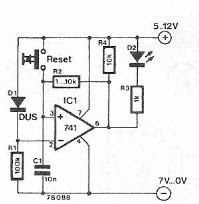
This circuit can be powered with a DC voltage between 5 and 12 volts.
Drop Voltage Indicator Circuit Diagram
This circuit can be powered with a DC voltage between 5 and 12 volts.
Monday, October 7, 2013
Polarity indicator circuit
Is is easy to test the polarity of a circuit’s point whether it is positive or negative by using the tester circuit featured here. The tester circuit has a high input impedance (around 1 megaohms) to avoid loading the point being tested. In testing sensitive points however, (inputs of opamps), the input impedance must be taken into consideration.

The opamp 741 is the core of the polarity indicator circuit. Its non-inverting input is used to test the points for polarity. It has a gain of around 150 which enables it to test low voltage levels. The test result is displayed through the two LED’s D1 and D2. D1 lights up by positive polarity and D2 lights up by negative polarity. Take note that the pin profile on the diagram is based on the TO-5 package profile.
Friday, October 4, 2013
Light Level Indicator Using a Window Comparator
The second example below uses a LDR (light dependent resistor) to indicate some desired light level. The LDR has a large dynimic range and varies in resistance from less than 100 ohms on a cloudy day to over a megohm in total darkness. A 2K pot was used to adjust the window range for usual room light conditions. This setup might also be used to indicate sunrise/sunset conditions.
Light Level Indicator Circuit Diagram
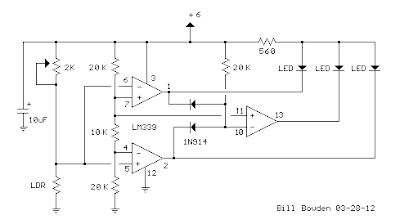
Light Level Indicator Circuit Diagram
Saturday, September 28, 2013
LM3914 battery level indicator

Battery level indicator circuit is a circuit that is used to measure the battery voltage / battery. The main components of the battery level indicator circuit is an LM3914 IC. LM 3914 on Circuit battery level indicator is a monolithic IC that detects an analog voltage. And drive the 10 LEDs that produce a linear analog display on a given input voltage.
IC LM3914 is easy to get in the market and not expensive. IC LM3914 battery level indicator on the circuit is often encountered in a series of peak indicator audio signals in analog audio equipment. Battery level indicator circuit consists of IC LM3914, 10 pieces of LED, and a few resistors. The scheme of battery level indicator can be seen below.
IC LM3914 is easy to get in the market and not expensive. IC LM3914 battery level indicator on the circuit is often encountered in a series of peak indicator audio signals in analog audio equipment. Battery level indicator circuit consists of IC LM3914, 10 pieces of LED, and a few resistors. The scheme of battery level indicator can be seen below.
 |
| LM3914 battery level indicator |
In the circuit of the battery level indicator on the supply circuit voltage taken from the battery / batteries through a switch. Didesaimn this circuit will only display the battery level when the switch is pressed. This is intended to save the battery voltage itself.
Subscribe to:
Posts (Atom)