Showing posts with label 1. Show all posts
Showing posts with label 1. Show all posts
Monday, December 16, 2013
7 1 Channel audio Surround Sound systems
7.1 Surround Sound Systems
7.1 channel audio systems is the modified version of 6.1 channel and plus provide additional realistic experience than 6.1 setup. at home this organization splits the single rear-hub amp into private not here- and moral-rear surround. These systems are not a stanch discrete 7.1 channel system to the same degree 7.1 formats don’t at this time exist. In a true discrete 6.1 surround method, the back center surround attitude is separate from the surround not here (SL) and surround right (SR) positions. A 7.1 channel system uses matrixes extended surround wherever the not here-back and right-back (rear-inside surround) multichannel are blended at once and stored. The assembly of a 7.1 setup is agreed voguish the Picture under.
 |
| 7.1 Channel audio Surround Sound system |

Thursday, November 7, 2013
1 4 wavelength Active Antenna
Antennas are much shorter than quarter wavelength impedance obtained is very small and highly dependent on the frequency. It was a difficult game impedances over a decade of frequency coverage. Instead, the phase of the input source-follower FET Q1. A high impedance input successfully bridges Antenna characteristics at any frequency.
1/4 wavelength Active Antenna Circuit Diagram

transistor Q2 is used as a follower, to provide a high impedance load for Q1, but more importantly that it makes to drive low-impedance amplifier coupled to commonly Q3, which each receive a voltage amplifier. Q3 Q4 turns transistor output impedance is relatively low in impedance, which is enough to drive 50 Three dimensional receiver, Antenna input impedance.
1/4 wavelength Active Antenna Circuit Diagram
Friday, November 1, 2013
1 3V DC to 12 2V DC Regulator Power Supply
Power supply circuit to generate output below were variations between 1.3V DC to 12.2V DC with 1A current.
In addition, the power supply circuit is also equipped with over-current protection or shield against belebih flow. Power supply circuit is very simple, but the quality is quite good, made her basiskan regulator IC LM723 is a pretty legendary.
In addition, the power supply circuit is also equipped with over-current protection or shield against belebih flow. Power supply circuit is very simple, but the quality is quite good, made her basiskan regulator IC LM723 is a pretty legendary.

Description:
R2 to set the output voltage. The maximum current is determined by R3, over-current protection circuit inside the LM723 to detect the voltage on R3, if it reaches 0.65 V, the voltage output will be off her. So the current through R3 can not exceed 0.65 / R3 although output short-circuit in his.
C3 and C4 are ceramic capacitors, as much as possible directly soldered to the PCB, this is because the LM723 is prone to oscillation that is not cool.
LM723 works with 9.5V input voltage to 40 V DC and the LM723 can generate its own current of 150mA when the output voltage is not more than 6-7V under input voltage.
Specifications:
Output (value estimated):
Vmin = (R4 + R5) / (R5 * 1.3)
Vmax = (7.15 / R5) * (R4 + R5)
Imax = 0.65/R3
Max. Power on R3: 0.42/R3
Min. DC Input Voltage (pin 12 to pin 7): Vmax + 5
Component List:
B1 40V/2.5A
C1 2200uF (3300uF even better)
C2 4.7uF
C3 100nF
C4 1NF
C5 330nF
C6 100uF
Green LED D1
D2 1N4003
F1 0.2A F
F2 2A M
IC1 LM723 (in a DIL14 plastic package)
R1 1k
R2 Pot. 5k
R3 0.56R/2W
R4 3.3k
R5 4.7k
S1 250V/1A
T1 2N3055 on a heatsink 5K / W
TR1 220V/17V/1.5
source [link]
Friday, October 11, 2013
AN374 1 Watt l 8 16 Volts Audio Amplifier
This is an amplifier circuit based on IC AN374 which has a 1 Watt output power with supply voltage and a maximum of at least 8 volts to 16 volts with the DC current. Following amplifier circuit 1 Watt l 8 - 16 Volts Audio Amplifier.
[Continue Reading]
 |
| 1 Watt l 8 - 16 Volts Audio Amplifier |
Monday, September 30, 2013
5 1 Classic Home Theater System Energy
Low Distortion and Resonance - spokesman method is distortion- otherwise resonance-without charge, but Energy has achieved a significantly decrease distortion level, a plainly audible perfection.

The Take Classic 5.1 home theater system also offers terrific performance and great features:
- Our patented Convergent Source Module (CSM) 3-edge your way poly-titanium woofer and .75-inch hyperbolic aluminum-field tweeter -the kindness of Energy speakers
- Patented corrugated Elliptical Surround woofers create from top to toe efficiency, low distortion
- An aluminum auditorium tweeter on behalf of sonic accuracy
- Front and rear venting for additional powerful low response
Take Classic raises the piece for 5.1 narrator classification performance. It includes a powerful 200-watt subwoofer with a front-firing seaport, 8-shuffle driver and wavy Elliptical Surround™ in support of deep with the intention of you feel when much as hear. The Convergent Source Module (CSM), with its 3-shuffle poly-titanium woofer and .75-inch hyperbolic aluminum-pitch tweeter, focuses sound for clearer dialogue and stirring melody. The CSM gives soundtracks a dynamic frequency range and a colossal soundstage, used for smooth, realistic sound from every one satellite lecturer and the base channel. song and motion picture lovers rejoice. Take Classic puts the passion back into your favorite films.
Exclusive Energy® Brand Technologies
Convergent Source Module
The Convergent Source Module, before CSM, provides broad dispersion, low distortion and amazing midrange performance. The lecturers midrange and tweeter are positioned inside close proximity to individual an alternative and accomplish seeing that a single source, by this means increasing overall dispersion and falling some lobing effect. The chambering of the middle and tweeter lowers the drivers resonance, plummeting distortion.
wavy Elliptical Surround knowledge
Energys patented ridged Elliptical Surround technology (U.S. patent #6,725,967, Canadian patent #2,407,123) increases excursion, eliminates distortion and raises efficiency on woofers and subwoofers. The Elliptical Surround encompasses the conduit, allowing it to move identically concerning both instructions, follow-on in come up to nil distortion. And while standard designs are often plagued with surround dimpling, which causes them to give off in and off of segment and distort on all listening levels, Energys designs arent influenced by dimpling on all, as a substitute proprietary grooved Elliptical Surround expertise allows representing a better conduit come up, resultant trendy greater efficiency. This design as well lets the conduit do greater crest to peak movement, in this way allowing it to travel added than bend in half the distance of the competition. These attributes enable Energy woofers and subwoofers to move incredible amounts of air, ultimately allowing them to joke about drop frequencies with greater low lean-to and fidelity.
come again?s voguish the Box
A 6-example, soaring spin black place of Energy Take Classic 5.1 speakers: 4-Take satellite speakers, 1-faultlessly matched Take interior channel spokeswoman, 1-perfectly matched Take powered subwoofer; 1-owners guide.
Technical Specifications
- Frequency Response - Sat: 115Hz-20KHz; Center: 110Hz-20KHz; Subwoofer: 33Hz-150Hz +/- 3dB
- Crossover purpose - 2.9 kHz
- Sensitivity - 89dB
- Power use - Sat & core: 100 Watts; Subwoofer: 200 Watts
- Recommended Amplifier Power - 20 - 100 Watts RMS (permanent)
- Impedance - 8-ohm compatible
- Subwoofer adaptable Low Pass Filter - 40Hz-150Hz @ 18dB/octave
- Tweeter - ¾-shuffle (19 mm) Hyperbolic™ aluminum-ground
- Woofer - Sat & crux: 3-edge your way poly-titanium; junior: 8" IM cone-shaped tool with Patented grooved Elliptical Surround
- Dimensions (inches) - Sat: 6 7/8 x 4 1/8 x 4 1/8; Center: 4 1/8 x 10 1/4 x 4 1/8; Subwoofer: 12 5/8 x 12 5/8 x 12 5/8 (add 2 1/6" pro feet)
- power - Sat: 2.9 lbs; foundation: 3.2 lbs; Subwoofer: 19.7 lbs
Performance Tips:
The center channel spokeswoman needs to be alive centrally located so so as to the dialogue appears to be approach from the center of the screen. It needs to be more than or else underneath the overseer, while faithfully to it as feasible. If youon the subject of using a rear projection television, the nearly all likely option is to place it over the screen. If you say a front projection method, you have choices-rack mounting, otherwise placement on furniture, in support of illustration. It is principal, though, to place the orator so to facilitate its front frame is even with the edge of the shelf or else stand underneath it. unsolicited diffraction occurs whilst the foundation channel is too far back into a cabinet or else other exterior with edges with the aim of possibly will impede sound dispersion.
In support of not here or else utterly front channels, the distance concerning the speakers be supposed to live 6-8 feet on smallest amount for the greatest stereo imaging. The optimum extent identity is rectangular, with the speakers along solitary of the shorter walls, facing the opposite margin. If probable, figure out not place speakers hostile to a fence or else by rear of a bookshelf; corner placement is generally the most evil option. Try to keep the speakers-especially rear vented models-next to smallest amount two feet from the plane behind it, save you manipulation a vent plug. pro superlative results mounting on a rear cage up, pose the speakers so they flank the major listening area and item with regard to the front of the opportunity. They be supposed to be situated raised to a height of approximately six feet and ought to ideally give a window of six feet involving them.
The three a good number normal subwoofer locations include corners (which can upshot taking part in boomy otherwise exaggerated low frequency response), placement along a mountain, away from the corner (producing moderate low performance with increased fidelity terminated corner placement), otherwise beside a front spokeswoman (creating a better blend with the front speaker, but sacrificing overall volume). Experimentation with subwoofer placement is highly encouraged; slight adjustments can create giant differences clothed in sound reproduction. To test subwoofer placement, install it in the short term in your chief listening attitude and march around the listening space while on stage a familiar bit of melody until you catch the most excellent sounding position.
The three a good number normal subwoofer locations include corners (which can upshot taking part in boomy otherwise exaggerated low frequency response), placement along a mountain, away from the corner (producing moderate low performance with increased fidelity terminated corner placement), otherwise beside a front spokeswoman (creating a better blend with the front speaker, but sacrificing overall volume). Experimentation with subwoofer placement is highly encouraged; slight adjustments can create giant differences clothed in sound reproduction. To test subwoofer placement, install it in the short term in your chief listening attitude and march around the listening space while on stage a familiar bit of melody until you catch the most excellent sounding position.
Tuesday, September 17, 2013
AN374 1 Watt l 8 16 Volts Audio Amplifier
This is an amplifier circuit based on IC AN374 which has a 1 Watt output power with supply voltage and a maximum of at least 8 volts to 16 volts with the DC current. Following amplifier circuit 1 Watt l 8 - 16 Volts Audio Amplifier.
[Continue Reading]
|
| 1 Watt l 8 - 16 Volts Audio Amplifier |
Wednesday, September 11, 2013
Making Home Theater 5 1 Surround Amplifier

Actually, 5.1 channel amplifier consists of 6 amplifiers 1 channel mono, which has certain specifications on each canals. Has 6 channel surround sound amplifier that consists of Front Left | Center | Front Right | Rear Left (Left Surround) | Rear Right (Right Surround) | and LFE (Subwoofer).
For clarity I give a simple illustration of the layout and the circuit for these speakers.
For clarity I give a simple illustration of the layout and the circuit for these speakers.
 |
| 5.1 Speaker Setup |
Accoustic Field Generator
Acoustic Field Generator is generating acoustic sound with surround effects are adjustable with a standard Dolby Surround, able to produce surround sound is good enough but not too much need of funds. Technological developments as if not only focused on one area alone but on all fronts. The development of technologies that exist today one of them is in the field of audio. With more advanced audio technology today not only as mere entertainment but has become a hobby, hobby is not cheap of course. Many audio enthusiasts trying to make music sound that sounded to be very hard to make music sound as live, the addition of the amplifier, woofer or special speakers that cost is not cheap.
The sound effects are living seems to now is something that most do not have to exist in every good audio devices. This effect is basically a surround effect that can lead to sound as though coming from different directions and his voice can still be heard clearly. Currently Compo-tape tape that has been a lot of these facilities surround sound but not good enough when heard from a considerable distance because of the effects surroundnya missing. This is because the distance is too far listener and speaker, speaker layout is not quite right, or the effect of unfavorable surround.
Surround effects are nice and can be heard with a good surround system is a system that is in movie theaters and to make it not a bit prangkat needed funds. However, if satisfaction remains the number one then the fund is not a major problem. To find a middle ground between price and quality surround effects it was attempted to make the Acoustic Field Generator that can produce surround sound is good enough but not too much need of funds. Acoustic Field Generator is capable of generating acoustic sound with surround effects are adjustable with a standard Dolby Surround.
Accoustic Field Generator Construction
Basically an Acoustic Field Generator built from op-amp circuit and filters. Op-amps are usually used as a voltage amplifier in the Acoustic Field Generator is more widely used as active filters. The filter in the tool is very instrumental in creating an acoustic sound that is really clear, but in practice, almost all the filters, do not miss the precision of the signal with a specific frequency. An op-amp is good for this application is the op-amp which has a wide bandwidth, rise time, slew rate and fast setting timenya. In addition to op-amp and active filter, theres more important parts of the power supply. This is the part that is instrumental in creating excellence acoustic sound because of the bad power supply which is the only producer of noise, which will enter into a voice signal path so that should clear acoustic sound into an acoustic sound with the addition of reverberation (noise). The power supply used is the twin power supply + / - 18 volts DC. Part Acoustic Field Generators
Before we start doing this project, it helps us know in advance about the function of each speaker.
Front Channel
Channel Front is a forward channel input signal LR. LR signal is passed to an amplifier with gain = 1 so that this signal is passed without change / to filter the input signal LR. Front Left and Front Right, is a public speaker that we encountered in stereo amplifier, consisting of a woofer and tweeter. Woofers generally produce low tone sound with a frequency range ranging from 80Hz - 250Hz, while the tweeter produces a high tone with a frequency range between 15kHz - 20kHz. For projects that we will create, its good we use a good quality woofer, with a size of 10 inches and a type piezoelectric tweeter for each speaker fronts.
Channel Front is a forward channel input signal LR. LR signal is passed to an amplifier with gain = 1 so that this signal is passed without change / to filter the input signal LR. Front Left and Front Right, is a public speaker that we encountered in stereo amplifier, consisting of a woofer and tweeter. Woofers generally produce low tone sound with a frequency range ranging from 80Hz - 250Hz, while the tweeter produces a high tone with a frequency range between 15kHz - 20kHz. For projects that we will create, its good we use a good quality woofer, with a size of 10 inches and a type piezoelectric tweeter for each speaker fronts.
 |
| Front Channel 5.1 Amplifier |
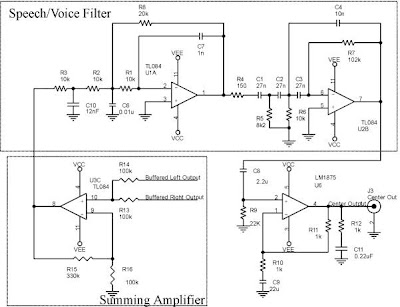
Center Channel
Center, the fullrange speakers, which produce sound with a frequency range between 80Hz - 10Khz. Output from the center speaker is a summation of left and right signal (left + right = center). In a movie or song Dolby Surround format, commonly used center for dialogue / vocal or speech of the actor / artist of a film and to produce a sound that moves ahead of us.
 |
| Center Channel 5.1 Amplifier |
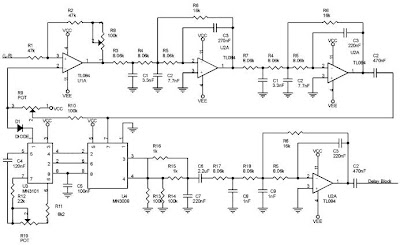
Rear Channel with Surround System
In this section is the core of this hard perangakat. These sections produce surround effects. To produce the surround effect is required special IC MN3005 / 8 and MN3101. Both these ICs will delay the incoming signal in several phases, so that the signal output from this phase will be left with a signal phase of the signal lain.Pada this section L and R are deducted (LR) and then passed in the buffer, filter LPF, delay line, filter LPF (7KHz) and the last is a splitter between the signals R and L. Circuit which causes the surround effect is 75KHz LPF circuit that produces its output fed to the Right Rear 75KHz LPF amplifier input while it diparalel with the Left Rear amplifier input so as to produce two signals L and R which is basically a LR signal a phase lag with the original signal phase.
Rear Left and Rear Right, also known as surround speakers. This speaker is generally a semi-midrange speaker (usually used on television or Mini Compo), commonly called satellite speakers. In a movie surround speakers are used to generate the audible sound of distant voices or sounds that move from the back of our approach. In a music surround speakers produce sound backing vocals and generally sounds like guitars, violins and trumpets sounded clear here.
 |
| Rear Channel 5.1 Amplifier |
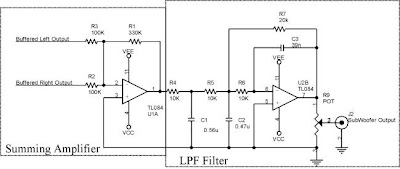
Subwoofer Channel
Part of this subwoofer is the summation of inputs L and R inputs to a summing amplifier. The output of the summing amplifier is passed to a class 2A LPF which will only pass signals with frequency rendah.Subwoofer, sometimes referred to as LFE (Low Frequency Effect). For these speakers using a subwoofer speaker. Speaker woofer speaker subwoofer is designed specifically to be able to respond to sound with a very low frequency, ranging from 15Hz - 120Hz. For low tone effect can be produced by either (without any harmonic frequency), then the acoustic box / box speakers are also designed specifically with a variety of methods (there are no visible speaker / inside the box, there are that use insulation / labyrinth, etc. ), so that the speaker is capable of compressing the air effectively, so that will feel the effect.
 |
| Subwoofer Channel 5.1 Amplifier |
 |
| Wiring Diagram Home Theater Amplifier / 5.1 Amplifier |
Subscribe to:
Posts (Atom)